
The Forex market looks confusing from the outside. Big words, fast charts, and numbers moving every second can make anyone feel lost. But behind all this complexity, the Forex market works very much like real life. If we understand it step by step, it becomes simple, logical, and even interesting.
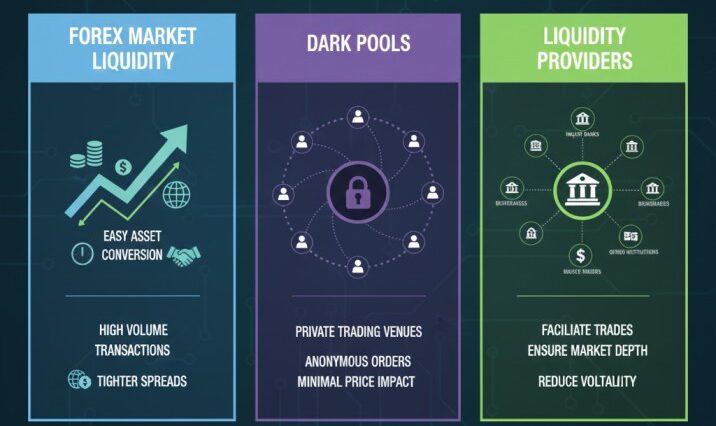
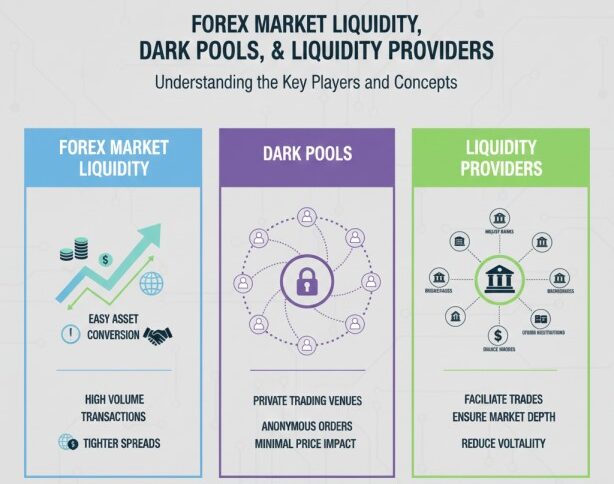
To truly understand Forex, we must understand three very important ideas:
1. Forex Market Liquidity
2. Liquidity Providers
3. Dark Pools
Let’s explore them slowly and simply.
What Is Forex Market Liquidity?
Liquidity is the ability of a financial asset to be quickly bought or sold in the market at a stable price with minimal cost.
Daily Life Example:
Imagine you go to a busy fruit market.
Apples are everywhere. Many buyers and sellers are looking to buy and sell. You can buy or sell apples instantly at a fair price
This market is highly liquid.
Now imagine a small village where only one person sells apples.
- Few buyers
- Few sellers
Prices can change suddenly.
This market has low liquidity.
Forex Market Liquidity Explained
The Forex market is the most liquid market in the world because:
- Trillions of dollars are traded every day.
- Banks, companies, governments, and traders are always buying and selling currencies
Because of high liquidity:
- You can enter and exit trades easily.
- Prices move smoothly.
- Costs like spreads are usually low.
In simple words:
Forex liquidity means how easily currencies are exchanged without price problems.
Why Is Liquidity Important in Forex?
Liquidity is like oxygen for the Forex market.
When Liquidity Is High:
- Trades execute fast
- Prices are stable
- Less manipulation
- Lower trading costs
When Liquidity Is Low:
- Sudden price jumps
- Slippage (you don’t get the price you expected)
- Higher risk
Example:
If you try to exchange USD to EUR during London or New York sessions, liquidity is high and prices are fair.
But if you trade during late night hours, liquidity is low and prices can behave strangely.
- High liquidity = smooth driving on a highway
- Low liquidity = driving on a broken road
Who Creates Liquidity? (Liquidity Providers)
Liquidity doesn’t appear magically. Someone has to provide it.
These people or institutions are called Liquidity Providers (LPs).
What Are Liquidity Providers?
Liquidity providers are big financial institutions that:
- Constantly buy and sell currencies.
Make sure there is always someone on the other side of a trade
Examples of Liquidity Providers:
- Large international banks.
- Central banks.
- Hedge funds.
- Major financial institutions
Simple Example:
Think of a money exchange shop at an airport. They are always ready to buy or sell currency. You don’t need to wait for another traveler
That shop is acting like a liquidity provider.
In Forex:
Liquidity providers make sure that when you click buy or sell, your trade gets filled instantly.
How Retail Traders Access Liquidity?
Small traders like us cannot trade directly with big banks.
So how do we trade?
The Chain Looks Like This:
Big Banks → Liquidity Providers → Brokers → Retail Traders
Your broker connects you to liquidity providers.
That’s why a good broker matters.
If a broker has:
- Strong liquidity providers
- Multiple sources of liquidity
Then you get:
- Better prices
- Faster execution
- Lower spreads
5. What Are Dark Pools?
The term dark pool sounds scary, but it’s not illegal or evil.
A dark pool is simply a private trading place where large institutions trade without showing their orders to the public.
Why Do Dark Pools Exist?
Imagine a bank wants to exchange $1 billion worth of currency.
If this order appears on the open market:
- Prices will move sharply.
- Other traders will react.
- The bank will get a bad price.
To avoid this, they trade in dark pools.
Simple Example:
Imagine you want to buy 100 houses in one city.
If people know:
- Prices will rise instantly.
Instead, you buy quietly through private deals.
That’s exactly what dark pools do.
Are Dark Pools Bad?
No. Dark pools are necessary for big players.
They help:
- Reduce market shock
- Protect large orders
- Maintain market stability
But there is one thing to understand:
Retail traders cannot see dark pool activity, which means:
- Big moves may happen suddenly.
- Prices can change without clear reason.
This is why sometimes Forex moves without obvious news.
How Liquidity, Dark Pools, and Price Work Together?
Let’s connect everything.
- Liquidity providers create buy and sell orders
- Dark pools handle large hidden transactions
- Public Forex market shows smaller visible trades
When:
- Liquidity is high = Market is calm
- Large orders enter dark pools = Price may later adjust.
- Liquidity dries up = Volatility increases
This is why understanding liquidity is more important than indicators.
Conclusion:
The Forex market is not random. It is a living system, powered by liquidity.
- Liquidity is the blood
- Liquidity providers are the heart
- Dark pools are the hidden veins
When liquidity flows smoothly, the market stays healthy. For a trader, success doesn’t come from chasing signals. It comes from respecting liquidity, understanding who controls the flow, and trading with patience.
If you understand liquidity,
you don’t fight the market,
you move with it.