
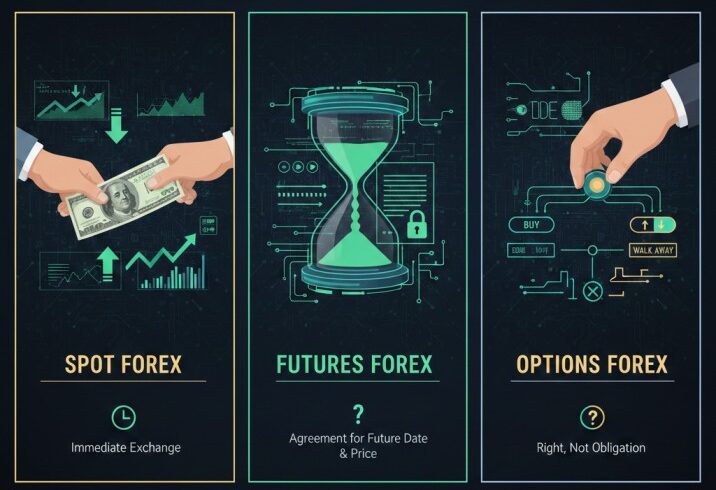
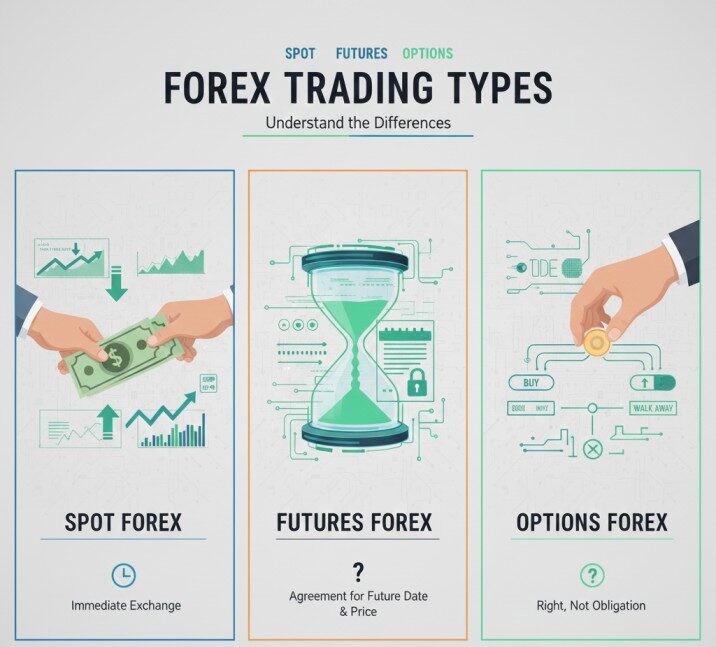
The Forex market is the heartbeat of global finance. Every second, millions of people, businesses, and institutions exchange currencies because the world is constantly moving, trading, traveling, and growing. But this vast market becomes much easier to understand when we break it down into the three simple methods of trading currency: Spot Forex, Futures, and Options.
In simple words, Spot is “trading right now,” Futures is “locking a price for later,” and Options is “reserving a price if you need it.” Once these three ideas click, the entire Forex market starts to make sense.
Although all three means buying and selling currencies, they exist for different reasons and solve different problems.
In this article, we will learn what these three methods are, why they exist, and how it helps in the market.
1.Spot Forex: (For Immediate Trading)
What Is Spot Forex?
Spot Forex is the most common and simplest form of currency trading. It means buying or selling a currency at the current market price, known as the spot price.
In simple words:
Spot Forex = Trading currency right now.
There are no fixed contract sizes, no expiry dates, and trades can be opened or closed anytime the market is open.
Why Does Spot Forex Exist?
Let’s understand with the help of an example:
Imagine you are travelling from Pakistan to Turkey for a holiday.
When you reach the airport, you go to the exchange counter and give them Pakistani Rupees (PKR). In return, they give you Turkish Lira (TRY) immediately.
- No waiting.
- No contract.
- No future date.
You get the money right now, at the price available right now.
This instant currency exchange is called Spot Forex.
Spot Forex exists because people like travellers, need foreign currency instantly to pay for hotels, food, transport, and shopping.
If this immediate exchange did not exist:
- You couldn’t get Lira on the spot
- You couldn’t travel peacefully
- Businesses couldn’t accept payments
- International transactions would slow down
Spot Forex keeps global travel, trade, and payments running smoothly.
How Does Spot Forex Work?
Even though you trade instantly, actual settlement happens after 2 business days (T+2). Some pairs like USD/CAD settle faster.
2. Forex Futures: (For Locking Prices)
What Are Forex Futures?
Forex Futures allow you to fix a currency price today for an exchange that will happen in the future.
You simply make a deal and sign a contract by setting the future price earlier.
In simple words:
Futures = Agree on a price now through contract and complete the trade later.
These contracts:
- Have fixed sizes
- Have fixed expiry dates
- Are traded openly and transparently
- Require margin (a deposit)
Why Do Futures Exist?
Let’s understand with the help of an example:
Imagine you are travelling to Turkey next month.
You know today that 1 US Dollar = 30 Pakistani Rupees.
But you worry that next month, the dollar might become more expensive.
So, you make a deal today with a bank:
“I will buy 100 dollars from you next month at 30 PKR per dollar.”
No matter what happens to the dollar later, you pay the agreed price.
This is exactly how Forex Futures works. You lock a currency price today for a trade and enjoy the perks in the future.
Who needs to make Forex Futures?
- Importers
- Exporters
- Multinational companies
- Airlines
- Banks
These organizations deal with foreign currencies months in advance. A sudden rise or fall can cause huge losses. Futures give them price certainty.
Simple Example:
A Japanese company must pay $5 million to a U.S. supplier after three months.
If the U.S. dollar becomes stronger, the payment will become more expensive in yen.
To avoid this risk, the company buys USD futures today.
This locks today’s exchange rate.
Even if the USD rises after three months, their cost remains the same.
Why Does the Market Need Futures?
- Without futures, companies would constantly fear currency fluctuations.
- Futures create stability, predictability, and confidence in international business.
- That’s why they are essential to the larger economic system.
3. Forex Options: (For Flexible Protection and Limited Risk)
What Are Forex Options?
Forex option lets you buy or sell currency at a fixed price if you want, before a certain date. You pay a small fee for this choice.
Simple meaning:
Options = Reserve a price now, but use it only if it benefits you.
There are two types of Options.
- Call Option: Right to buy currency
- Put Option: Right to sell currency
Why Do Options Exist?
Let’s understand this with the help of an example:
Imagine you are travelling to Turkey in two months.
Today, 1 USD = 30 PKR. You are worried the dollar might get more expensive later.
You pay a small fee to a bank for the right to buy dollars at 30 PKR anytime in the next two months.
If the dollar rises to 35 PKR, you use your option and buy at 30 PKR, saving money.
If the dollar stays at 30 PKR or goes lower, you don’t use the option. You only lose the small fee you paid.
Benefits Forex Options Provide:
- Forex Options gives you protection. Because sometimes traders and businesses want protection, but not strict commitment.
- Limited risk (maximum loss is only the premium).
- Freedom to use the contract only if the price is favorable.
- Smart hedging during uncertain events (elections, crises, big announcements)
Simple Example:
A trader buys a call option for EUR/USD at 1.08, paying a $50 premium.
If EUR/USD rises to 1.11, the trader exercises the option and profits.
If EUR/USD stays below 1.08, the trader simply ignores it.
Maximum loss = $50 premium.
Conclusion
Spot Forex, Futures, and Options are three pillars that support the entire global currency system. Spot trading keeps daily currency flow active. Futures bring stability to long-term international business. Options provide flexible protection with controlled risk.
Together, they make the Forex market efficient, secure, and adaptable for everyone from beginners to global corporations.