
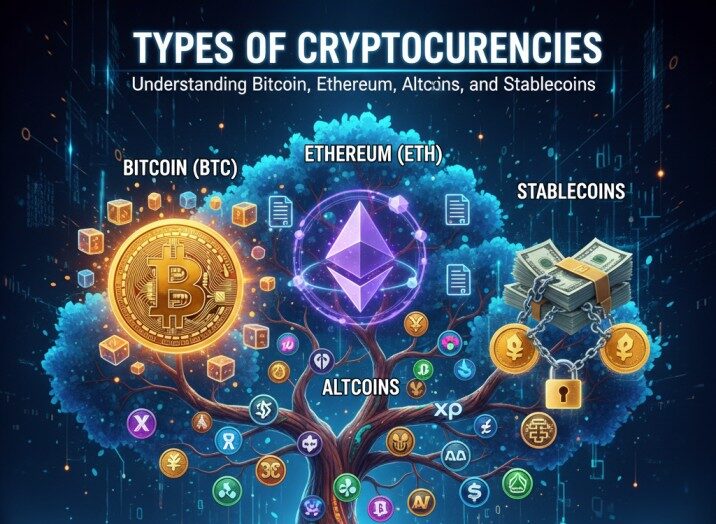
Cryptocurrencies have grown far beyond a single digital coin. What began in 2009 with Bitcoin has now expanded into an entire ecosystem of digital assets, each designed with a specific purpose, technology, and use case. Whether you trade, invest, or simply want to better understand crypto, knowing the different types of cryptocurrencies is essential.
Here, we will explore four major categories: Bitcoin, Ethereum, altcoins, and stablecoins —what they are, how they work, and why they matter.
1. Bitcoin: The First and Most Valuable Cryptocurrency
Bitcoin (BTC) is often called the “king of cryptocurrencies.” It was the first digital currency and still holds the highest market value. Introduced in 2009 by the mysterious Satoshi Nakamoto, Bitcoin solved one major problem:
How can people send money online without banks?
Bitcoin uses blockchain technology to record transactions and relies on decentralization, meaning no government or financial institution controls it.
Key Features of Bitcoin
Limited supply: Only 21 million BTC will ever exist.
Decentralized network: No central authority manages it.
Store of value: Often compared to “digital gold.”
Secure and transparent: Every transaction is recorded on a public ledger.
Proof-of-Work consensus: Miners use computing power to validate transactions.
Bitcoin’s purpose is simple:
To act as a global, borderless digital currency.
Because of its scarcity, many investors treat Bitcoin as a long-term asset, storing it the way people store gold during uncertain economic times.
2. Ethereum: More Than Just Digital Money
Ethereum (ETH), created by Vitalik Buterin in 2015, took cryptocurrency beyond transactions. Unlike Bitcoin, Ethereum’s primary goal is not just to send or store money — it aims to build an entire **decentralized digital world.
The real innovation behind Ethereum is its smart contract technology.
What Are Smart Contracts?
Smart contracts are digital agreements that run automatically when conditions are met — with no human involvement.
For example:
- Paying rent automatically once the due date arrives
- Releasing funds after a project milestone
- Running decentralized apps without a central server
Because of this, Ethereum became the foundation of:
- DeFi (decentralized finance)
- NFTs
- Decentralized apps (dApps)
- DAOs (decentralized organizations)
Key Features of Ethereum
- Smart contract platform
- Programmable blockchain
- Massive developer ecosystem
- Used for NFTs, tokens, DeFi, and Web3 applications
- Shifted to Proof-of-Stake (PoS) to reduce energy consumption
Ethereum is not just a cryptocurrency; it is a technology layer powering thousands of blockchain projects.
3. Altcoins: Every Cryptocurrency That Isn’t Bitcoin
The term altcoins stands for “alternative coins.”
Anything that is not Bitcoin falls into this category.
Altcoins were created to improve the limitations of Bitcoin or serve new functions. They vary widely in design, purpose, and technology.
Major Types of Altcoins
a. Utility Tokens
These coins are used inside a specific platform or service.
Examples:
BNB (used for Binance fees and services)
Chainlink (LINK) (connects smart contracts to real-world data)
b. Payment Altcoins
Designed for fast and low-cost transactions.
Examples:
- Litecoin (LTC)
- Dash (DASH)
- Bitcoin Cash (BCH)

c. Privacy Coins
Focus on hiding transaction details and protecting user identity.
Examples:
- Monero (XMR)
- Zcash (ZEC)
d. Meme Coins
Started as jokes but grew due to community hype.
Examples:
- Dogecoin (DOGE)
- Shiba Inu (SHIB)
e. DeFi Tokens
Used in decentralized finance platforms.
Examples:
- Uniswap (UNI)
- Aave (AAVE)
f. Layer-1 and Layer-2 Protocol Coins
Aim to improve blockchain performance.
Examples:
- Solana (SOL)
- Polygon (MATIC)
- Avalanche (AVAX)
Why Altcoins Matter
Altcoins add diversity to the crypto ecosystem. They bring new ideas, solutions, and technologies. Some are risky, some are reliable, and some become the backbone of new industries.
4. Stablecoins: Crypto Designed to Stay Stable
Unlike most cryptocurrencies, which fluctuate in price, stablecoins are designed to stay steady. Their value is usually tied to a real-world asset — most commonly the US dollar (USD).
This makes stablecoins extremely useful for traders who want the benefits of crypto without the price volatility.
Types of Stablecoins
a. Fiat-Backed Stablecoins:
Backed by real currency stored in banks.
Examples:
- USDT (Tether)
- USDC (USD Coin)
b. Crypto-Backed Stablecoins
Backed by other cryptocurrencies but over-collateralized to reduce risk.
Example:
- DAI (MakerDAO)
c. Algorithmic Stablecoins
Use algorithms to balance supply and demand.
These are riskier and often unstable.
Where Stablecoins Are Used?
- Trading and transferring money
- Saving without volatility
- Lending and borrowing in DeFi
- Cross-border payments
- Protecting funds during market crashes
Stablecoins are the bridge between traditional finance and the crypto world.
Conclusion:
Cryptocurrency is no longer a single technology or a single coin. It is an evolving ecosystem made up of different digital assets, each serving a unique purpose.
- Bitcoin introduced decentralized money.
- Ethereum opened the door to smart contracts and Web3.
- Altcoins expanded innovation across many sectors.
- Stablecoins brought stability into a volatile market.
Understanding these categories helps you make better decisions as a trader, investor, or learner in the crypto space. As the industry grows, each type of cryptocurrency will continue shaping how digital finance works in the future.