
Stock exchanges are the backbone of the financial world, providing platforms where investors can buy and sell stocks, bonds, and other securities. These exchanges play a critical role in the economy by facilitating capital flow, promoting transparency, and enabling companies to raise funds. Among the most famous exchanges are the New York Stock Exchange (NYSE) and NASDAQ, but there are many important exchanges worldwide.
Understanding how these markets work is essential for traders, investors, and anyone looking to engage in the stock market.
What is a Stock Exchange?
A stock exchange is a regulated marketplace where securities, such as stocks and bonds, are traded. Companies list their shares on an exchange to raise capital, while investors trade these shares to generate profits or diversify their portfolios. Exchanges ensure fair pricing, liquidity, and regulatory compliance, which helps maintain investor confidence.
Key Functions:
- Facilitates the buying and selling of stocks.
- Provides price discovery, determining the market value of securities.
- Ensures transparency through strict regulations and reporting standards.
- Offers liquidity, allowing investors to enter or exit positions easily.
Major Stock Exchanges
- New York Stock Exchange (NYSE):
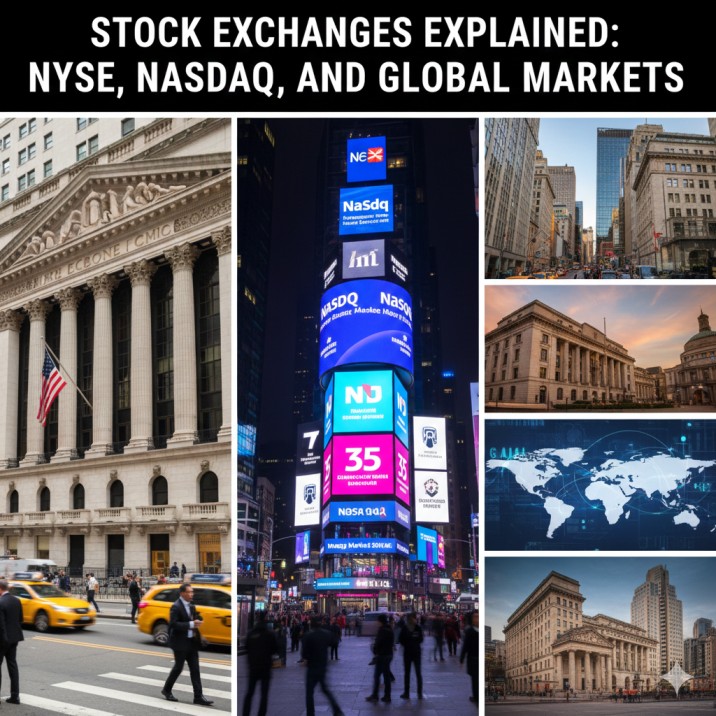
The NYSE, located on Wall Street in New York City, is the largest and oldest stock exchange in the world. It is known for its physical trading floor and strict listing standards.
Features:
- Operates on a hybrid system, combining electronic trading with floor trading.
- Lists some of the world’s largest companies, including Coca-Cola, IBM, and Walmart.
- Known for stability and large-cap stocks.
2. NASDAQ:
NASDAQ is the world’s second-largest stock exchange and is famous for technology and growth-oriented companies like Apple, Microsoft, and Amazon.
Features:
- Fully electronic trading platform.
- Attracts high-tech, biotech, and innovative companies.
- Known for volatility, offering opportunities for high-risk, high-reward trades.
Other Global Exchanges
- London Stock Exchange (LSE): One of the oldest exchanges in Europe, hosting multinational corporations and UK-based companies.
- Tokyo Stock Exchange (TSE): Japan’s largest exchange, known for blue-chip and industrial stocks.
Shanghai Stock Exchange (SSE): Major hub for Chinese companies, critical for investors in Asia.
How Stock Exchanges Work?
Stock exchanges operate through market orders, limit orders, and electronic trading platforms. Here’s a simplified overview:
1. Company Listing: A company decides to go public through an **Initial Public Offering (IPO)**. Its shares are listed on an exchange for investors to trade.
2. Buying and Selling: Investors place orders via brokers. The exchange matches buyers and sellers to ensure smooth transactions.
3. Price Determination: Stock prices fluctuate based on supply and demand, influenced by company performance, market sentiment, and economic indicators.
4. Regulation: Exchanges are governed by regulatory bodies (e.g., the SEC in the US) to prevent fraud and maintain investor trust.
Importance of Stock Exchanges
Stock exchanges are critical to both companies and investors:
For Companies:
- Raises capital for expansion, research, and operations.
- Provides visibility and credibility.
For Investors:
- Offers opportunities to buy shares in established and growing companies.
- Allows portfolio diversification across sectors and geographies.
- Provides liquidity, ensuring investors can sell shares when needed.
Example: A tech startup listing on NASDAQ can attract global investors, funding research and innovation while allowing shareholders to trade shares freely.
Conclusion:
Stock exchanges like the NYSE, NASDAQ, and other global platforms are essential for the functioning of modern financial markets. They provide liquidity, transparency, and investment opportunities for both companies and investors. By understanding how these exchanges operate, the types of companies listed, and the factors that influence performance, investors can make informed, strategic decisions in the stock market.