
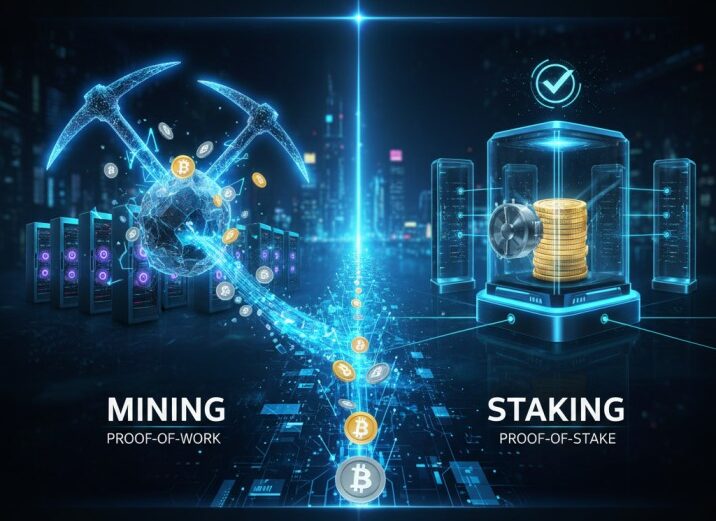
Cryptocurrency networks do not rely on banks or governments to issue new coins. Instead, they use powerful systems that allow users to secure the network in exchange for rewards. The two most common methods are mining and staking. Both play a major role in keeping blockchains functional, decentralized, and trustworthy.
- Mining uses computational power.
- Staking uses locked crypto funds.
- Both secure the blockchain but work in very different ways.
Understanding these systems will help you choose better networks, make smarter investments, and see where long-term opportunities exist.
What Is Mining in Cryptocurrency?
Mining is the original way of validating transactions on a blockchain. Bitcoin introduced this system in 2009. In mining, computers solve difficult mathematical puzzles. The first machine to solve the puzzle gets to add the next block to the blockchain and receives a reward.
This system is called Proof of Work (PoW).
How Mining Works?
- Miners use specialized machines.
- These machines compete to solve cryptographic problems.
- The fastest one earns the right to add a new block.
- The miner receives a block reward plus transaction fees.
Mining requires:
- Strong hardware
- High electricity power
- Cooling systems
- Technical knowledge
Because of this, mining is expensive but rewarding for those who can operate it at scale.
Why Mining Matters?
Mining provides security. When thousands of powerful computers compete to validate transactions, it becomes almost impossible for hackers to manipulate the blockchain. This is why Bitcoin’s security is considered unmatched.
Mining also ensures:
- Decentralization
- Transparency
- Fair distribution of rewards
And every time a miner adds a new block, new coins enter circulation. This is how new Bitcoins are created.
What Is Staking in Cryptocurrency?
Staking is a more modern and energy-efficient method used by many new blockchains. Instead of running powerful machines, users lock their crypto in a wallet to support the network. In return, they earn rewards over time.
This system is called Proof of Stake (PoS).
How Staking Works?
- You purchase a cryptocurrency that supports staking.
- You lock it in a staking wallet or a staking pool.
- The network selects validators based on how much they stake.
- Validators confirm transactions and create new blocks.
- They receive staking rewards for their contribution.
Staking does not require hardware or high electricity usage. This makes it more accessible for beginners.
Why Staking Matters?
Staking secures the blockchain just like mining, but with fewer resources. It supports:
- Faster transaction speeds
- Cheaper fees
- Lower energy consumption
- More participation from everyday users
Popular staking networks include Ethereum 2.0, Cardano, Solana, Polkadot, and Avalanche.
How Rewards Work in Mining and Staking?
Rewards help motivate users to secure the network. They vary depending on the blockchain.
Mining Rewards:
- Block rewards (newly created coins)
- Transaction fees
- Halving events reduce mining rewards over time
For example, Bitcoin decreases its mining reward every four years. This increases scarcity and affects price behavior.
Staking Rewards:
- Percentage returns (APY)
- Compounding options
- Extra tokens from network incentives
Staking rewards depend on how much you stake and how long you keep your coins locked.
Which One Is Better: Mining or Staking?
It depends on your goals, resources, and experience.
Mining Is Better If:
- You have access to cheap electricity
- You can afford high-end mining hardware
- You want exposure to Bitcoin
- You enjoy technical setups
Staking Is Better If:
- You want passive income
- You want low-risk participation
- You prefer eco-friendly options
- You don’t want to manage hardware
- You want to support faster networks
For most beginners, staking is easier, safer, and more practical.
Future of Mining and Staking
The crypto industry is shifting toward sustainable systems. Many projects are moving from mining to staking because of environmental concerns and speed limitations. However, mining will remain important as long as Bitcoin exists and Bitcoin is not going anywhere.
Staking, on the other hand, will continue to grow. More investors see it as a way to earn steady returns while supporting the blockchain.
Conclusion:
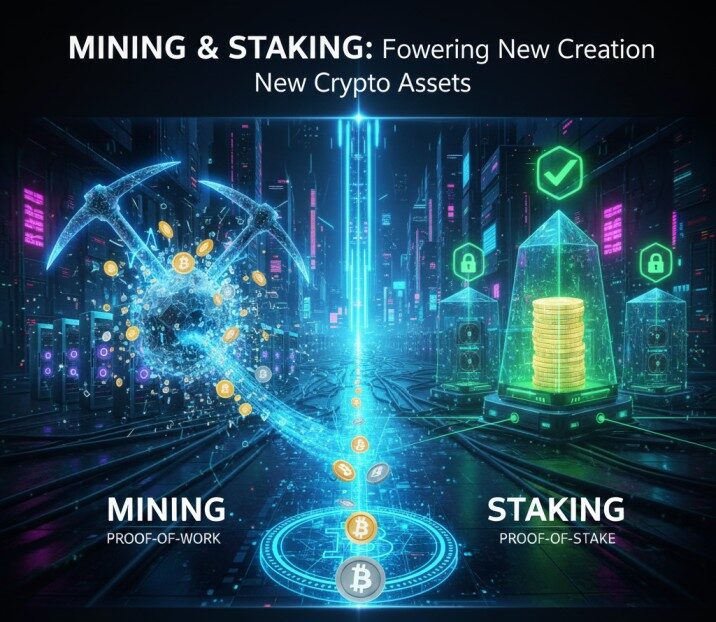
Mining and staking are the backbone of cryptocurrency networks. Mining brings unmatched security through computational power, while staking offers a modern, efficient way to validate transactions.
- Both systems create new coins.
- Both systems keep blockchains safe.
- And both reward users for contributing to the network.
If you understand how mining and staking work, you understand how new crypto is created, and why blockchain technology remains secure, decentralized, and powerful.