
An Initial Public Offering (IPO) is one of the most important events in a company’s financial journey. It marks the moment a private company becomes publicly traded by offering its shares to the general public for the first time. IPOs attract massive attention from retail traders, long-term investors, and institutions because they often represent growth potential, high profitability expectations, and early investment opportunities.
Whether you are a beginner in the stock market or an active trader, understanding IPOs is essential for recognizing high-value investment opportunities and avoiding unnecessary risks.
What Is an IPO?
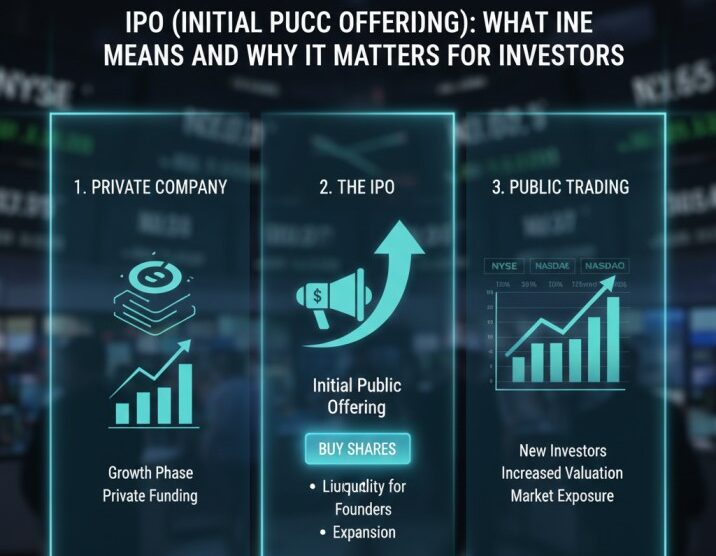
An IPO (Initial Public Offering) is the process through which a privately-owned company lists its shares on a stock exchange such as NYSE, NASDAQ, LSE, or others. Before the IPO, the company’s ownership was limited to founders, early investors, and venture capitalists. After the IPO, anyone can buy and sell shares.
Why Companies Launch IPOs?
Companies decide to go public to achieve one or more of the following:
- Raise Capital for Expansion
Funds from IPOs are used for scaling operations, research and development, marketing, debt repayment, and entering new markets.
- Increase Brand Credibility
A public listing increases trust among customers, investors, and global markets.
- Provide Exit to Early Investors
Founders, venture capitalists, and early stakeholders can sell their shares after the IPO.
- Employee Stock Options (ESOPs)
IPOs allow companies to offer shares to employees, motivating them with ownership benefits.
How an IPO Works (Step-by-Step)?
The IPO process involves multiple stages to ensure transparency, regulation, and fair valuation.
1. Decision to Go Public:
The company determines whether it is ready to meet regulatory requirements, financial reporting standards, and investor expectations.
2. Hiring Underwriters:
Investment banks (like Morgan Stanley, Goldman Sachs, JPMorgan) act as underwriters. Their role includes:
- Evaluating company value
- Setting the IPO price range
- Ensuring compliance
- Marketing the offering to institutional investors
3. Due Diligence & Filing:
The company prepares detailed documents such as:
- Prospectus (complete financial statements)
- Risk disclosures
- Business model & future plans
These are submitted to regulatory bodies such as the SEC in the U.S.
4. Roadshows & Marketing:
Before the IPO launches, the company promotes itself to big investors to build demand. This phase is called a roadshow, where presentations are held across financial hubs.
5. Pricing the IPO:
Underwriters finalize the IPO price based on demand, valuation, financial performance, and overall market conditions.
6. Listing on the Stock Exchange:
On the launch day:
- Shares are offered to the public
- The stock begins trading
- Market forces (supply & demand) determine the opening price
Key Terms Every Investor Must Know!
1. Offer Price:
The fixed price at which shares are sold during the IPO subscription period.
2. Listing Price:
The price at which the stock starts trading on the exchange on the listing day.
3. Oversubscription:
When demand for shares is higher than supply. Oversubscribed IPOs often list with strong gains.
4. Lock-In Period:
A duration (typically 3–12 months) during which early investors cannot sell their shares.
5. Underpricing:
Sometimes IPOs are priced lower than their market value to ensure a successful listing, often leading to immediate price jumps.
Why Investors Prefer IPOs?
1. Early Entry Advantage:
Investors can buy shares at the initial offer price before the stock becomes expensive.
2. Potential for High Returns:
Some IPOs deliver massive listing gains.
Examples from history:
- Alibaba
- Nvidia
These companies generated huge long-term returns.
3. Portfolio Diversification:
IPOs allow investors to add high-growth companies, especially in technology, finance, biotech, and energy.
4. Transparency:
Public companies follow strict reporting standards, giving investors access to financial data and performance metrics.
Risks Associated With IPO Investing
Despite the excitement, not every IPO performs well. Risks include:
1. Volatility:
Newly listed stocks can rise sharply or crash within minutes of the opening bell.
2. Hype vs Reality:
Companies may be overvalued due to marketing hype, not actual financial strength.
3. Limited Price History:
Investors have no long-term data to analyze trends, making predictions harder.
4. Lock-In Expiry Selling Pressure:
When the lock-in period ends, early investors may sell large amounts of shares, causing the price to fall.
How to Evaluate an IPO Before Investing?
To make smart decisions, investors should analyze:
- Company Fundamentals: Revenue, profit, debt, cash flow
- Industry Position: Competitive advantage, market demand
- Valuation: Compare with existing listed competitors
- Use of Funds: Understand how the company plans to utilize raised capital
- Management Team: Experience and track record
- Prospectus: Key risks and financial disclosures
Strong fundamentals = Higher chances of long-term success.
Conclusion:
An IPO (Initial Public Offering) is a major milestone that allows companies to raise capital and investors to participate in early growth opportunities. While IPOs can deliver high profits, they also involve risk due to volatility and limited historical data.
By analyzing company fundamentals, valuation, and market conditions, investors can make informed decisions and identify the IPOs that offer the best long-term potential.