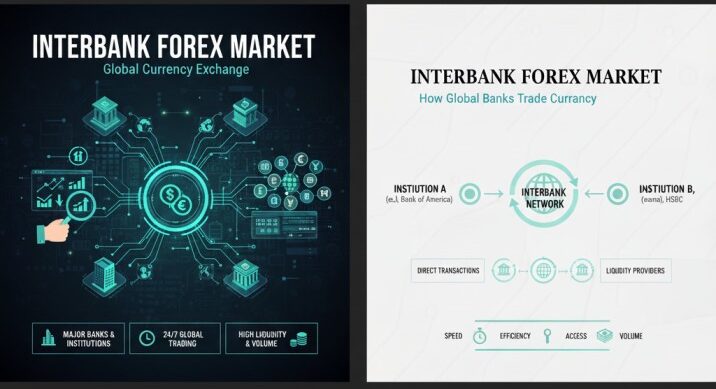
The Interbank Forex Market is the core of the global currency market. It is where the world’s biggest banks exchange currencies with each other. Every forex rate you see on your trading app or money exchange counter is ultimately influenced by this market.
To understand it properly, let’s start from the very basics and move step by step toward advanced steps.
What Is the Interbank Forex Market?
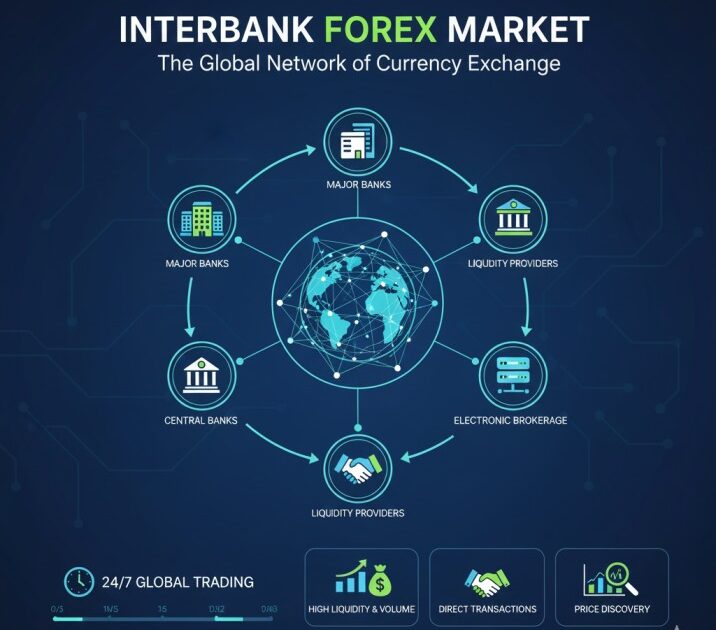
The interbank forex market is a network of international banks, central banks, hedge funds, and financial institutions that buy and sell currencies in large volumes at wholesale exchange rates, without using a centralized exchange.
Unlike stock markets, the interbank forex market does not exist in one physical building. It operates electronically 24 hours a day, connecting banks across the world.
Why Is It Called “Interbank”?
The word “interbank” means “between banks.”
These banks include:
- Commercial banks (like Citi, HSBC)
- Investment banks (like JP Morgan, Goldman Sachs)
- Central banks (like the US Federal Reserve)
These banks trade currencies to:
- Fulfill customer needs
- Manage international payments
- Control risks
- Make profits
A Very Simple Example
Imagine this situation:
A US company wants to pay €1 million to a company in Europe.
The US company goes to its bank.
The bank needs euros, so it goes to another bank that has euros.
The two banks exchange USD for EUR.
This exchange happens inside the interbank forex market.
So:
Every international payment passes through the interbank market.
Who Participates in the Interbank Forex Market?
1. Large Commercial Banks
These banks handle:
- Customer currency exchanges
- International trade payments
- Forex speculation
Examples:
- Deutsche Bank
- Barclays
- Citibank
2. Central Banks
Central banks participate to:
- Control inflation
- Stabilize their currency
- Influence interest rates
For example: If a country’s currency is falling rapidly, its central bank may buy its own currency in the interbank market to support it.
3. Institutional Players
Large institutions like:
- Hedge funds
- Multinational corporations
- Asset managers
They trade huge volumes and access interbank pricing through banks.
How Big Is the Interbank Forex Market?
The interbank forex market is the largest financial market in the world.
- Daily trading volume: Over $7 trillion
- Trades happen every second
- Major currencies like USD, EUR, JPY dominate
Because of this massive size:
No single trader can control the market alone.
How Are Exchange Rates Decided?
Exchange rates in the interbank market are decided by:
- Supply and demand
- Interest rates
- Economic news
- Political events
Simple Example:
If many banks want to buy US dollars, the price of USD goes up. If many banks want to sell USD, its price goes down.
Retail traders see prices that are derived from these interbank rates.
How Does the Interbank Market Affect Retail Traders?
Retail traders do not trade directly in the interbank market.
Instead:
Banks → Liquidity providers → Brokers → Retail traders
So when you place a forex trade:
Your broker is connected to the interbank market through liquidity providers.
The better the broker’s connection, the closer your price is to the real interbank rate.
Why the Interbank Forex Market Is Important
The interbank forex market:
- Sets global exchange rates
- Supports international trade
- Enables cross-border investments
- Stabilizes global financial systems
Without it:
International business and global payments would collapse.
Conclusion:
The Interbank Forex Market is where banks trade currencies with each other.It is the foundation of the entire forex market.
Retail traders depend on prices that originate from this market. It operates globally, electronically, and 24/5.
If you understand the interbank forex market, you understand where forex prices truly come from and that is the first step toward becoming a smarter forex participant.