
Every quarter, financial markets hit a moment where everything seems to pause.
Charts slow down. Traders wait. Investors hold their breath.
Why?
Because it’s earnings season. This is the time when companies reveal their real performance and set the tone for the next 90 days.
If you truly want to understand how stocks move, why a company rallies 12% overnight, or why a “strong company” suddenly drops like a stone…
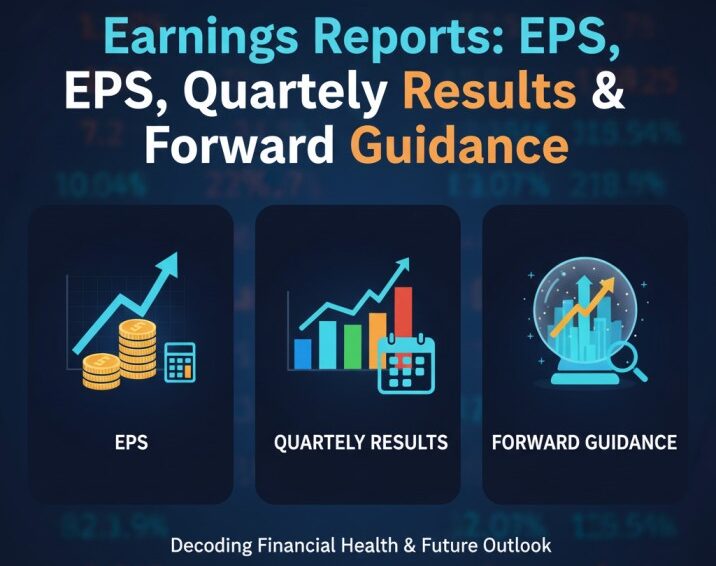
You need to understand EPS, quarterly results, and guidance at a conceptual level, not the overcomplicated textbook level.
What Exactly Are Earnings Reports?
Earnings reports are quarterly financial updates that companies release to show:
- How much did they earn?
- How much did they spend?
- How efficiently do they work?
- And what do they expect next?
In simple terms, it’s the company saying: “Here’s what we did. Here’s where we stand. And here’s where we’re heading.”
These reports matter because they directly shape:
- Stock prices
- Investor confidence
- Market sentiment
- Future buying/selling behavior
One good quarter can trigger a rally.
One bad quarter can erase months of steady gains.
EPS: The Heartbeat of Earnings Reports
EPS (Earnings Per Share) might look like a small number, but don’t underestimate its impact. It’s the first thing traders search for on earnings day.
Here’s what it really means:
EPS = How much profit the company made per share outstanding.
- If EPS is rising, the company is getting efficient.
- If EPS is falling, something is slowing down inside the machine.
But here’s the twist:
Markets don’t react to EPS alone.
They react to whether EPS beats expectations.
A company can show “good” earnings but still crash because analysts expected something even better.
That’s why you see headlines like:
“Company beats revenue but misses EPS — stock drops 7% after hours.”
Expectations matter as much as results.
Quarterly Results — The Real Story Behind the Numbers
Quarterly results give you the complete performance snapshot. They usually include:
1. Revenue (Top Line):
How much money did the company bring in before costs?
Growing revenue = strong demand
Shrinking revenue = product, pricing, or market problems
2. Net Income (Bottom Line):
This is the real profit after expenses.
This number often influences long-term investors more than short-term traders.
3. Operating Margin:
How efficiently the company is running its business.
Higher margins = strong management
Lower margins = rising costs or weak pricing power
4. Cash Flow:
Cash is king.
Even profitable companies can fail if they don’t manage cash well.
5. Debt Levels
Investors hate unnecessary debt, especially in high-interest-rate environments.
When you read quarterly results, ask yourself:
- Are revenues growing or slowing?
- Are profits stable?
- Are margins healthy?
- Is the company burning cash or building a cushion?
This mindset separates traders from spectators.
Forward Guidance — The Hidden Force Behind Market Reactions
This is where earnings season becomes emotional.
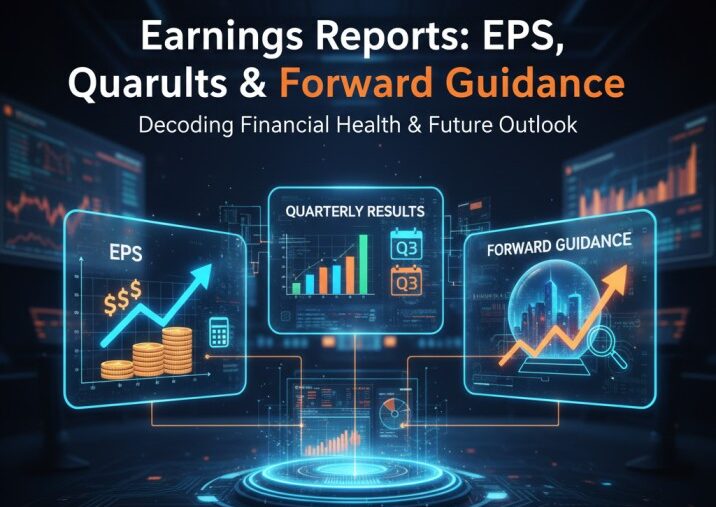
Guidance is the company telling investors:
“Here’s what we expect next quarter or next year.”
Sometimes the earnings report is solid…
But the guidance is weak…
And the market crashes instantly.
Why?
Because the market trades the future, not the past.
Guidance includes:
- Expected revenue
- Expected EPS
- Expected growth plans
- Risk warnings
- Market challenges
- Expansion strategies
If guidance is optimistic, even a weak quarter can trigger a rally.
If guidance is cautious, even strong results can’t save the stock.
Guidance controls sentiment, and sentiment controls price.
How Earnings Influence Stock Prices
Several things happen instantly after an earnings release:
1. After-hours volatility:
Most earnings drop after the market close.
Expect sudden spikes, gaps, and unpredictable swings.
2. EPS surprise triggers movement:
- Beat = bullish
- Miss = bearish
Even by a few cents, it matters.
3. Guidance sets the tone
Investors focus more on “what’s next” than “what just happened.”
4. Big players react first
Institutions move millions within seconds.
Retail traders react later, usually emotionally.
Why Earnings Matter More in 2026?
In 2026, markets are becoming even more data-driven and reactive.
High inflation, shifting tech adoption, and geopolitical uncertainty all increase earnings sensitivity.
That means:
- EPS volatility will continue
- Guidance will become stricter
- Misses will be punished harder
- Beats will create short-term opportunities
For traders, earnings season is not just “information.”
It’s an opportunity window.
Conclusion:
- Earnings reports are not just financial statements; they are emotional events that move markets.
- EPS tells you the company’s profitability.
- Quarterly results tell you how healthy the business is.
- Guidance tells you what the future looks like.
When you understand all three, you stop reacting… and start predicting.
- In trading, knowledge isn’t power.
- Understanding is power.
- And earnings reports are the clearest window into how a company is truly performing.