
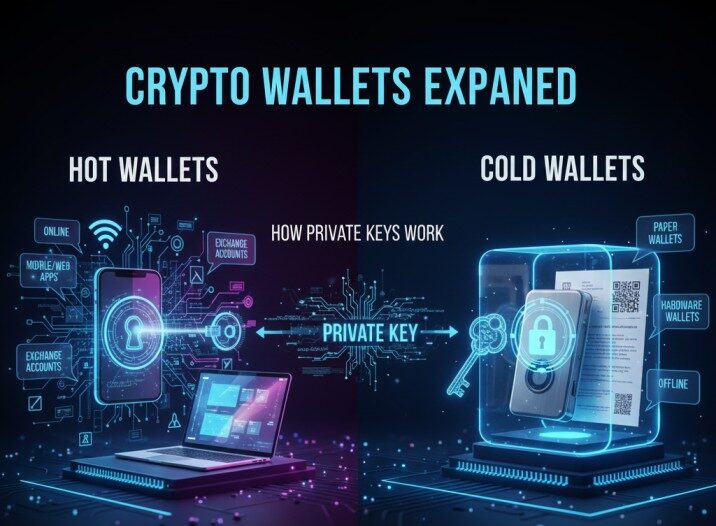
If you want to enter the world of cryptocurrency, you must understand one thing clearly: your wallet is your bank. In traditional banking, your money sits inside a physical institution. In crypto, your money lives on the blockchain, and your wallet is what gives you access to it. It is important to choose the right wallet and understand private keys for better decisions.
Many beginners make the mistake of thinking crypto wallets “hold” their coins. But that’s not true. A crypto wallet simply stores the keys that prove you own your coins on the blockchain. Once this idea is clear, everything about hot wallets, cold wallets, and private keys becomes much easier.
What Is a Crypto Wallet?
A crypto wallet is a digital tool that helps you send, receive, and store cryptocurrencies. Think of it as your personal control panel for interacting with the blockchain.
A wallet does two major things:
- Stores your private keys
- Let’s you access your crypto assets whenever you need them
You can send Bitcoin, trade Ethereum, store stablecoins, or interact with decentralized apps, but none of that is possible without a wallet.
There are two major types of crypto wallets you should know:
1. Hot Wallets (connected to the internet)
2. Cold Wallets (offline storage)
Both have different levels of security, convenience, and use cases.
Understanding Private Keys (The Core of Crypto Ownership)
Before comparing hot and cold wallets, it’s important to understand private keys, because this is where real ownership lies.
A private key is a long string of characters similar to a password that gives you access to your crypto. Anyone who has your private key can control your funds.
Your private key = complete ownership
This is why crypto experts say:
“Not your keys, not your coins.”
If your keys are stored with an exchange, you do not fully control your assets. If the exchange is hacked or freezes your account, you can lose access.
Types of keys you will encounter:
- Private Key: Full access to your wallet
- Public Key: Used to generate addresses people can send crypto to
- Seed Phrase / Recovery Phrase: A 12–24 word backup that lets you recover your wallet if you lose your device
Never share your private key or seed phrase with anyone. No customer support, no friend, and no message box should ever receive it. Keeping it safe is your responsibility.

Hot Wallets (Convenient but More Exposed)
A hot wallet is a crypto wallet connected to the internet. It is easy to access, quick to use, and perfect for daily transactions.
Examples of Hot Wallets:
- Mobile wallets (Trust Wallet, Coinbase Wallet)
- Desktop wallets (Exodus, Electrum)
- Web wallets (MetaMask, browser extensions)
- Exchange wallets (Binance, Coinbase, KuCoin)
Benefits of Hot Wallets:
Hot wallets are extremely popular because they offer:
- Ease of use — perfect for beginners
- Instant access — ideal for traders and active users
- Simple setup — no hardware required
- Compatibility with DeFi apps and NFTs
If you trade often, swap tokens, or use decentralized applications, a hot wallet is the easiest option.
Risks of Hot Wallets
Because they stay online, hot wallets come with higher risks:
- More exposed to hacking
- Phishing attacks
- Malware infections
- Exchange security breaches
This doesn’t mean hot wallets are unsafe; they are simply less secure than offline options. They are best for small or medium amounts, not large, long-term holdings.
Cold Wallets (The Safest Way to Store Crypto)
A cold wallet is an offline crypto wallet. It never touches the internet, making it one of the safest ways to store digital assets. Cold wallets are popular among long-term investors and people holding large amounts of crypto.
Types of Cold Wallets
1. Hardware Wallets:
These are physical devices that store your private keys offline.
Examples:
- Ledger Nano S / X
- Trezor Model T
- SafePal
Hardware wallets are easy to use and offer strong protection.
2. Paper Wallets
A paper wallet is simply a printed piece of paper containing your private keys and wallet addresses. They are rarely used today because hardware wallets are much more practical and secure.
Benefits of Cold Wallets
Cold wallets offer maximum security:
- Private keys never go online
- Resistant to hacking
- Ideal for long-term holding
- Safe for large investments
This is why many serious investors prefer cold storage for their Bitcoin, Ethereum, and other major assets.
Risks of Cold Wallets
Even though they are secure, cold wallets also come with some challenges:
- Cost (hardware wallets are paid devices)
- Requires proper handling and storage
- If you lose the device and seed phrase, you lose your crypto forever
Cold storage is about security and requires responsibility.
Conclusion:
Crypto wallets are essential tools for anyone entering the digital asset space. Understanding private keys, hot wallets, and cold wallets helps you protect your funds and manage your investments with confidence.
- Your wallet doesn’t hold your crypto, it holds your keys.
- Hot wallets offer convenience.
- Cold wallets offer maximum security.
- Private keys are the foundation of true ownership.
Once you understand these basics, navigating the crypto world becomes much safer and much easier.