When entering the financial markets, traders and investors often hear three common terms: Cash Index,
Index Futures, and Index ETFs. Although they are connected to the same underlying market indices,
they function in very different ways.
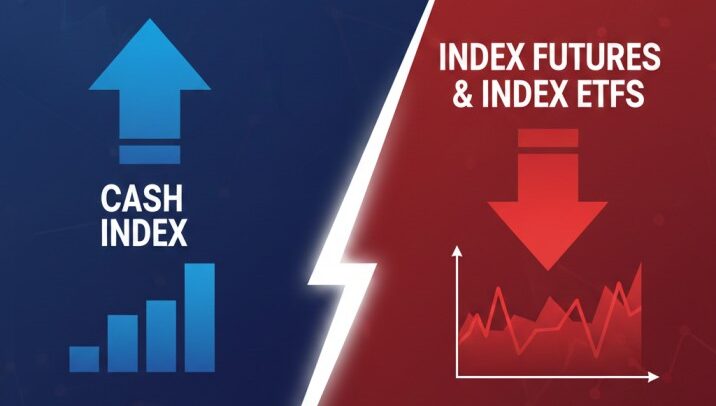
Understanding Cash Index vs Index Futures vs Index ETFs is crucial if you want to choose the right
instrument for trading, hedging, or long‑term investing. Many beginners assume these products are the same.
However, their structure, risk level, cost, and purpose are completely different.
In this in‑depth guide, we will break down:
• What is a Cash Index?
• What are Index Futures?
• What are Index ETFs?
• Spot index vs futures differences
• Leverage in futures trading
• Passive investing with ETFs
• Futures vs ETFs for hedging
• Which option is best for beginners or professionals?
Let’s start from the basics and build a clear understanding step by step.
What Is a Cash Index?
A Cash Index, also called a spot index, represents the real-time value of a group of selected stocks.
It reflects the overall performance of a market, sector, or economy.
For example, when the market says “the index is up 1% today,” it refers to the cash index value.
Important Characteristics:
• It is a benchmark, not a tradable asset.
• It shows the current market price.
• It has no expiry date.
• It does not involve leverage.
• It represents actual stock market movement.
You cannot directly buy or sell a cash index. Instead, it serves as a reference point
for ETFs, futures contracts, and other derivatives.
In simple terms, the cash index tells you what the market is doing right now.
What Are Index Futures?
Index Futures are derivative contracts that allow traders to speculate on the future price of an index.
These contracts have a fixed expiry date and are traded in the derivatives market.
When you trade index futures, you agree to buy or sell the index at a predetermined price
on a future date.
Key Features of Futures Contract Trading:
• Fixed contract size
• Expiry date (monthly or quarterly)
• Margin trading system
• High leverage
• Ability to go long or short easily
Leverage in futures trading allows traders to control a large position with a relatively small amount of capital.
For example, instead of paying the full value of the contract, you only deposit a margin.
This magnifies profits—but it also magnifies losses.
Index futures are widely used by:
• Day traders
• Institutional investors
• Hedge funds
• Portfolio managers for hedging
However, they are considered high-risk instruments and require strong risk management skills.
What Are Index ETFs?
Index ETFs (Exchange Traded Funds) are investment funds designed to track the performance of a specific stock market index.
They trade on stock exchanges just like individual shares.
When you buy an Index ETF, you indirectly invest in all the companies that make up the index.
For example, if an ETF tracks a 500‑stock index, your single ETF purchase gives you exposure to all 500 companies.
Key Benefits of Passive Investing with ETFs:
• Diversification
• Lower management fees
• No expiry date
• Easy to buy and sell
• Suitable for long-term investing
Unlike futures, ETFs usually do not offer high leverage.
They are considered beginner-friendly and ideal for investors who prefer steady, long-term growth over speculation.
Because of their simplicity and transparency, ETFs have become one of the most popular investment tools worldwide.
Spot Index vs Futures – Core Difference
The spot index (cash index) represents the current real-time value of the market.
Index futures represent the expected future value of that same index.
Sometimes, the futures price is slightly higher or lower than the spot price.
This difference occurs due to interest rates, dividends, and market expectations.
Professional traders often use this price difference for index arbitrage strategies.
Main Difference:
Spot Index = Present value
Futures = Future expectation
Understanding this concept is essential before entering futures trading.
Cash Index vs Index Futures vs Index ETFs – Detailed Comparison
Let’s break this down clearly.
Tradability:
Cash Index cannot be traded directly.
Index Futures and ETFs can be bought and sold.
Leverage:
Cash Index has no leverage.
Index Futures offer high leverage.
Index ETFs usually have no or low leverage.
Expiry:
Cash Index has no expiry.
Index Futures expire on specific dates.
Index ETFs have no expiry.
Risk Level:
Cash Index carries no direct risk because it is not tradable.
Index Futures carry high risk due to leverage.
Index ETFs carry moderate market risk.
Purpose:
Cash Index – Benchmark
Index Futures – Short-term speculation & hedging
Index ETFs – Long-term investment & portfolio building
Each instrument serves a different type of market participant.
Futures vs ETFs for Hedging
Institutional investors often use index futures to hedge large portfolios.
Because futures allow short selling and leverage, they are effective tools for risk protection.
Retail investors, on the other hand, often use ETFs for hedging.
Selling ETF units or buying inverse ETFs can help reduce portfolio risk.
The choice depends on:
• Portfolio size
• Risk tolerance
• Capital availability
• Trading experience
Both instruments can protect investments when used correctly.
Advantages and Disadvantages
Cash Index Advantages:
• Reliable market benchmark
• Reflects real-time sentiment
Cash Index Disadvantages:
• Not tradable
Index Futures Advantages:
• High liquidity
• Short selling flexibility
• Efficient hedging tool
Index Futures Disadvantages:
• High volatility
• Margin calls
• Expiry management
Index ETFs Advantages:
• Diversified exposure
• Cost-effective
• Beginner-friendly
• Long-term growth potential
Index ETFs Disadvantages:
• No high leverage
• Possible tracking error
Which One Should You Choose?
If you are a beginner investor, Index ETFs are usually the safest starting point.
They provide diversification and require minimal monitoring.
If you are an experienced trader who understands risk management and market timing,
Index Futures may offer higher short-term profit opportunities.
If you simply want to track overall market direction without trading,
the Cash Index acts as a reliable benchmark.
Always consider:
• Your financial goals
• Risk tolerance
• Time horizon
• Capital size
There is no one-size-fits-all answer.
The best instrument is the one that aligns with your strategy.
Final Thoughts
Understanding Cash Index vs Index Futures vs Index ETFs gives you a clear advantage in financial markets.
Many traders lose money simply because they do not fully understand the instruments they are trading.
Cash Index shows direction.
Index Futures offer leveraged trading opportunities.
Index ETFs provide long-term investment exposure.
By selecting the right instrument and applying disciplined risk management,
you can use these tools effectively for trading, investing, or hedging.
Make informed decisions, stay consistent, and always prioritize risk control over quick profits.