
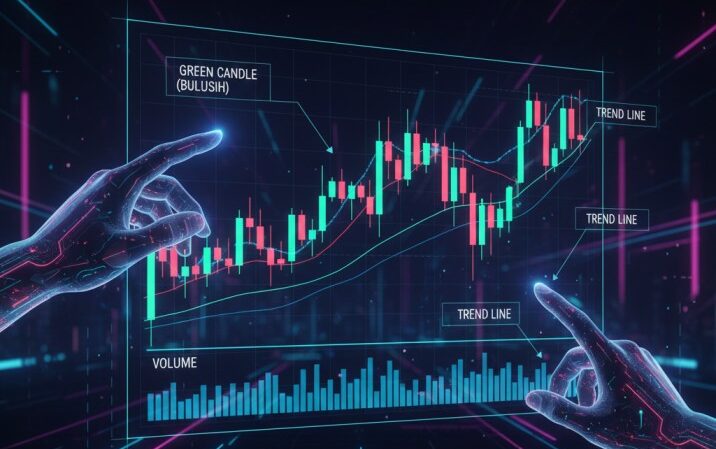
If you want to trade crypto confidently in 2026, you must master one skill: reading charts like a pro. Because in the crypto market, prices don’t move randomly; they leave clues. Candlesticks show emotions. Volume shows strength. Trends show direction. And when you learn to interpret all three together, you stop guessing and start predicting.
This guide breaks it down as simply as possible!
Why Reading Crypto Charts Matters?
Crypto is fast. Prices pump overnight and dump in seconds. News, hype, whale activity, everything hits the charts instantly.
If you can read the charts, you can:
- Spot reversals before other traders notice
- Identify strong entries and exit points
- Avoid buying into tops
- Protect your capital during uncertain market conditions
- Trade with confidence instead of emotion
In short, chart reading is your competitive advantage.
1. Candlestick Basics (What the Market Is “Feeling”?)
Every candlestick is a story. It tells you who was in control: buyers or sellers. How the market behaved over a specific timeframe.
The Anatomy of a Candle:
A candle has four data points:
1. Open: where the price started
2. Close: where it ended
3. High: the highest price
4. Low: the lowest price
If the candle is green, the price closed higher than it opened.
If it’s red, sellers pushed it lower.
Most Useful Candle Signals:
You don’t need to memorize 50 patterns. Focus on the few that actually matter:
1. Pin Bar (Long Wick):
When you see a long wick and a small body, it shows a rejection.
- Long upper wick = sellers rejected higher prices
- Long lower wick = buyers stepped in strongly
Perfect for spotting reversals.
2. Engulfing Candle:
A large candle that “engulfs” the previous one.
- Bullish engulfing = buyers taking control
- Bearish engulfing = sellers overpowering buyers
This usually predicts strong continuation in the engulfing direction.
3. Doji:
Open and close are almost equal.
This shows indecision; a trend might be slowing down.
Candles tell you what happened. But to understand why it happened, you need volume.
2. Volume: The Truth Behind Every Price Move:
Volume represents how many people traded during that time period.
High volume means conviction. Low volume means hesitation.
How to Use Volume Properly?
1. High Volume + Strong Candle = Real Move:
If price breaks resistance with a big green candle and high volume, the breakout is legit.
2. Low Volume + Breakout = Trap:
Many fake breakouts in crypto happen on low volume. Whales manipulate price just enough to trigger stops — then the candle reverses.
3. Volume at Support/Resistance:
- If support breaks with heavy volume, downtrend confirmation.
- If resistance breaks with heavy volume, uptrend confirmation.
4. Volume Spikes:
When volume suddenly shoots up, expect volatility.
This could be:
- A whale entering
- A liquidation cascade
- A trend reversal
Volume is your lie detector. It shows which candle moves you can trust — and which ones are illusions.

3. Trend Reading: The Skill That Separates Traders From Gamblers:
Never trade against the trend unless you enjoy losing money.
Crypto trends are usually fast, strong, and emotional, so your job is to spot them early and ride them safely.
How to Identify Trend Directions?
1. Higher Highs & Higher Lows: Uptrend
If every new peak is higher than the previous one, buyers are dominating.
2. Lower Highs & Lower Lows: Downtrend
Sellers are controlling price. Avoid long positions here.
3. Sideways (Range Market):
Price bounces between a clear support and resistance zone.
Perfect for:
- Scalping
- Short-term trades
- Accumulation
Using Moving Averages to Confirm Trends:
While the article focuses on raw chart reading, one simple indicator does help: MA lines.
- Price above 50-day MA: uptrend bias
- Price below 50-day MA: downtrend bias
But remember: the chart itself is always more important than the indicator.
4. Combining Candles, Volume & Trends (The Real Trading Skill)
Reading each individually is good.
Reading them together? That’s where real traders make real decisions.
Example 1: Bullish Scenario
- Price forms a bullish engulfing candle.
- It appears at support.
- Volume rises.
- The trend shows higher lows.
This setup is strong. It often signals the start of a new upward move.
Example 2: Bearish Scenario
- Price makes lower highs
- A large bearish pin bar forms at the resistance
- Volume spikes during the rejection
This signals strong selling pressure.
Best action? Avoid longs or look for short opportunities if your exchange allows it.
Example 3: Fake Breakout Warning
- Price breaks resistance
- The candle is small
- Volume is low
- Trend is unclear
This is a trap.
Most traders lose money in these moments because they chase price instead of reading clues.
If even one element disagrees, the trade is likely risky.
Conclusion:
Chart reading is not about memorizing patterns.
It’s about learning to understand market psychology. Every candle is an emotion. Every spike in volume is a decision. Every trend is a story.
Master this, and crypto trading stops feeling like guesswork and starts feeling like strategy.