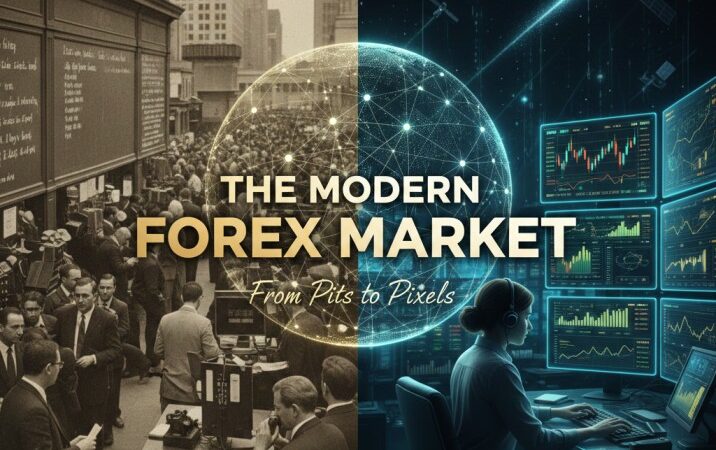
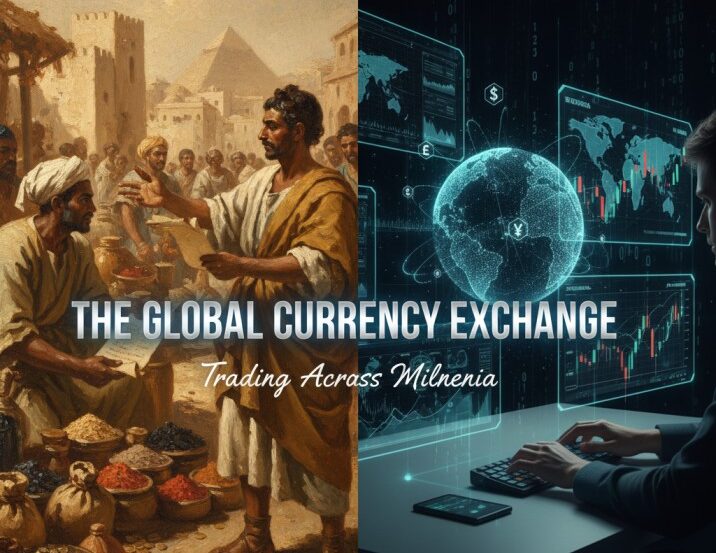
The story of the forex (foreign exchange) market is not just about money. It is the story of human connection, trust, technology, and progress. From people exchanging coins in crowded marketplaces to traders clicking buttons on mobile phones, the forex market has travelled a long and meaningful journey. Understanding this development helps us see how the world became financially connected and how currency exchange turned into the largest market on earth.
The Physical Beginning of Currency Exchange
In the earliest days of civilization, there was no concept of forex. People lived simple lives and used barter, meaning they exchanged goods directly. A farmer would trade wheat for cloth, or a potter would trade pots for grains. But barter had a problem: both people had to want what the other had.
To solve this, societies introduced money in physical form, such as gold, silver, and coins. When people from different regions met, they had different coins. To trade, they needed to exchange one currency for another. This was the earliest form of the forex market.
These exchanges happened physically:
- In marketplaces
- At ports
- With money changers sitting at small counters
- Everything was slow, manual, and based on trust.
Gold Standard: Bringing Stability
As trade between countries increased, people needed a reliable system. This led to the Gold Standard in the 19th century. Under this system:
- Each country fixed its currency value to gold
- Paper money could be exchanged for a fixed amount of gold
This made currency exchange more stable and predictable. If you knew how much gold backed a currency, you could calculate its value against another currency.
However, this system also had limitations:
- Gold supply was limited
- Economic growth was restricted.
- During wars, countries could not maintain gold reserves
Still, the Gold Standard laid a strong foundation for international currency exchange.
Bretton Woods System: A Controlled Global Forex Market
After World War II, the world needed financial order. In 1944, major countries met in the Bretton Woods Conference. They created a new system:
- The US dollar was linked to gold
- Other currencies were linked to the US dollar
- Exchange rates were fixed but adjustable
This system reduced chaos and encouraged global trade. Banks and governments became the main players in forex. Ordinary people had no access. Forex trading was still physical and institutional, done through:
- Banks
- Telephones
- Telex machines
It was professional, slow, and highly controlled.
Birth of the Modern Forex Market (1971)
In 1971, a major turning point came. The United States ended the gold link of the dollar. This decision changed everything. Currencies were now allowed to float freely based on:
- Demand and supply
- Economic strength
- Interest rates and politics
This moment gave birth to the modern forex market.
From this point:
- Exchange rates moved freely.
- Profit and loss became possible from price movements.
- Forex became a true market rather than a fixed system
Physical Trading Era: Phones and Paper
In the early modern forex market:
- Banks traded currencies with other banks.
- Deals were done over phones.
- Orders were written on paper.
- Prices were shared manually
This was called the interbank market. It was still not open to the public. Only large institutions could participate.
Trading floors were noisy, full of voices, urgency, and emotion. Speed mattered, but technology was limited.
Entry of Computers and Electronic Trading
In the 1980s and 1990s, computers slowly entered the financial world. This was a silent revolution. Banks started using:
- Electronic price screens
- Computerized order systems
- Faster communication networks
Later, Electronic Communication Networks (ECNs) allowed banks to see prices and trade instantly.
This reduced human error, increased speed, and made the market more transparent. Forex trading started moving from physical presence to digital screens.
Internet and Online Forex Trading
The real transformation happened with the internet. In the late 1990s and early 2000s:
- Online trading platforms were introduced.
- Retail traders (ordinary people) gained access
- Forex became available 24 hours a day
Now a person sitting at home could trade currencies that were once traded only by big banks.
Online forex trading made the market:
- Faster
- Cheaper
- More accessible
- Truly global
Mobile apps further changed everything. Forex trading moved from trading floors to pockets and palms.
Role of an Economist: Milton Friedman
One of the greatest contributors to this system was Milton Friedman, a Nobel Prize–winning economist. He strongly supported floating exchange rates.
His famous idea was:
“Flexible exchange rates are a shock absorber.”
Friedman believed that allowing currencies to move freely would help economies adjust naturally. His ideas influenced the collapse of fixed exchange systems and supported the modern forex market structure we see today.
Without such thinking, the online and free-flowing forex market may never have existed.
Forex Today: A Digital Heartbeat of the World
Today, the forex market is:
- Fully electronic
- The largest financial market in the world
- Operating 24 hours, 5 days a week
Trillions of dollars are exchanged daily, not with coins or paper, but with digital numbers on screens.
Conclusion:
The development of the forex market from physical exchange to online trading reflects human evolution. It shows how trust became systems, systems became technology, and technology became opportunity.
From dusty marketplaces to digital platforms, forex is not just a market, it is a living connection between nations, economies, and people.
It reminds us that progress is not sudden; it is built step by step, belief by belief, and idea by idea.