
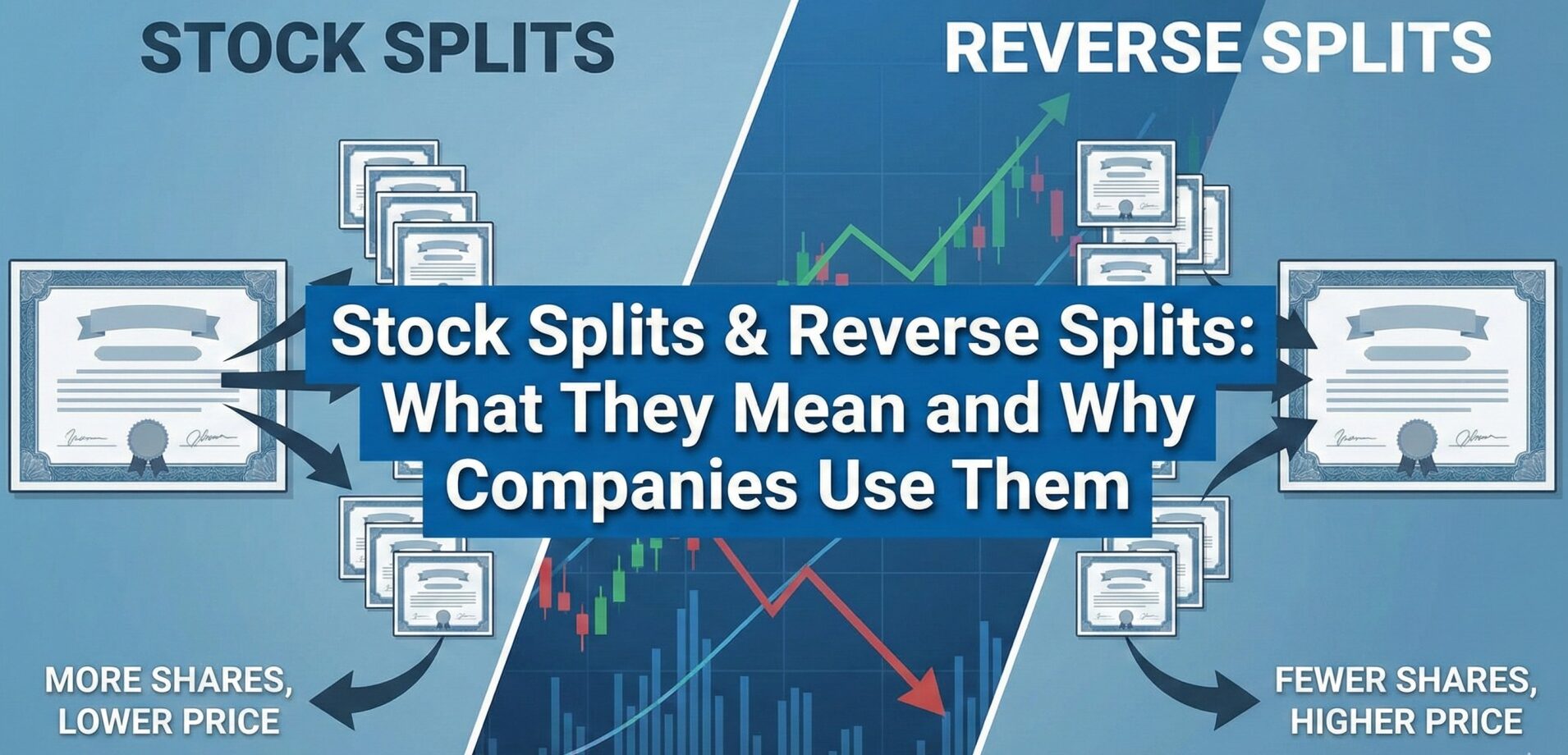
In the world of stock trading and investing, the terms stock splits and reverse stock splits come up frequently—especially when companies want to adjust their share price without changing their overall market value. Understanding these actions is essential for investors because they affect the number of shares they own, the price of each share, and sometimes the long-term perception of a company’s financial health.
This guide explains what stock splits are, how reverse splits work, their impact on investors, and why companies choose them.
What Is a Stock Split?
A stock split occurs when a company increases the number of its outstanding shares by issuing more shares to existing shareholders. Although the number of shares increases, the total value of the investment stays the same.
For example:
If you own 10 shares at $100 each and the company announces a 2-for-1 stock split, your shares double to 20, but the price becomes $50 per share.
Your investment value remains $1,000.
Stock splits are commonly seen in successful companies whose share prices have risen significantly, making the stock appear expensive to new investors.
Why Companies Perform Stock Splits?
Companies use stock splits for several strategic reasons:
1. To Make Shares More Affordable:
When a company’s stock price climbs too high, retail investors may find it difficult to buy. A split reduces the price and increases accessibility.
2. To Improve Liquidity:
A lower share price leads to more trading activity. More liquidity means easier buying and selling with tighter bid-ask spreads.
3. To Signal Confidence:
Companies like Apple, Tesla, and Amazon have used stock splits as a signal that they expect continued long-term growth.
4. To Attract New Investors:
A lower per-share price often draws in new market participants—especially beginners who prefer cheaper stocks over high-priced ones.
Types of Stock Splits
There are different ratios companies use when splitting shares:
- 2-for-1 split: Shares double, price halves
- 3-for-1 split: Shares triple, price becomes one-third
- 5-for-1 split: Shares multiply five times
- 10-for-1 split: Often seen in tech companies with fast growth
Regardless of the ratio, the overall market capitalization remains the same.
What Is a Reverse Stock Split?
A reverse stock split is the opposite of a regular split.
Here, a company reduces the number of outstanding shares, increasing the price per share. Again, the total value of the investment remains unchanged.
For example:
If you have 20 shares at $5 each, and the company does a 1-for-5 reverse split, your shares become 4, and each share becomes $25.
Your investment remains $100.
Why Companies Perform Reverse Splits?
Reverse stock splits often have a different purpose compared to normal splits:

1. To Avoid Delisting:
Stock exchanges like the NYSE and NASDAQ require companies to maintain a minimum share price (usually around $1).
A reverse split increases the price to meet compliance levels.
2. To Improve Corporate Image:
A very low stock price can suggest instability. Increasing the price through a reverse split can help improve market perception.
3. To Attract Institutional Investors:
Large investment firms often avoid penny stocks. Increasing the share price through a reverse split can help a company appear more stable and attract institutional buyers.
4. To Reduce Volatility:
Penny stocks are highly volatile. A higher share price after a reverse split often reduces extreme price movements.
Types of Reverse Stock Splits
Common reverse split ratios include:
- 1-for-2: Every 2 shares become 1
- 1-for-5: Every 5 shares become 1
- 1-for-10: Every 10 shares become 1
- 1-for-20 or 1-for-50: Used by struggling companies needing drastic price increases
Reverse splits maintain market cap but significantly change the stock’s trading profile.
Impact of Stock Splits on Investors
- Stock Splits:
Investors receive more shares at a lower price.
- The total value stays the same.
- Liquidity increases.
- Long-term investors often benefit as splits generally occur in strong companies.
- Psychology plays a role; many investors see splits as a positive signal.
- Reverse Splits
Investors end up with fewer shares at a higher price.
- The total value remains unchanged.
- Companies performing reverse splits may be facing challenges.
- Liquidity may decrease due to a higher price and fewer shares in circulation.
Do Splits Change Market Capitalization?
No. Both stock splits and reverse splits do NOT change market capitalization or the total value of a shareholder’s investment.
They only change the structure of shares—not the company’s underlying worth.
Conclusion:
Stock splits and reverse stock splits are important corporate actions that affect share price, liquidity, investor psychology, and market perception.
Stock splits are typically a positive signal associated with expanding companies, while reverse splits may indicate financial challenges or an effort to maintain exchange listing requirements.
For investors, understanding these adjustments helps in making smart, informed decisions, especially when evaluating long-term opportunities and risk levels. Knowing why a company announces a stock split or reverse split can provide deeper insight into its financial health, strategy, and future outlook.