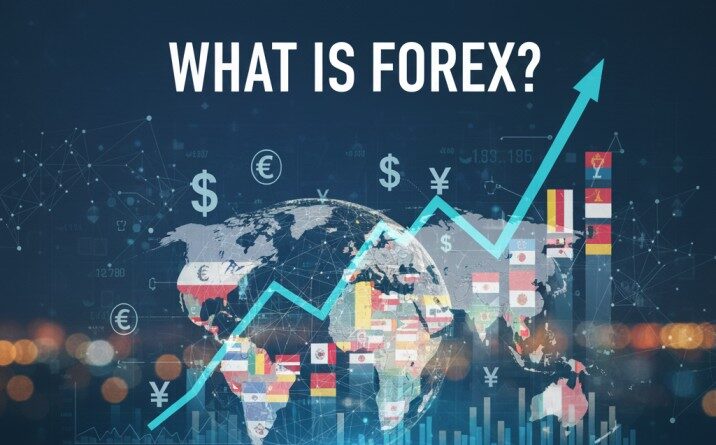
Forex is made of two words: ‘for’ and ‘ex’. Here, ‘for’ stands for foreign and ‘ex’ stands for exchange. In short, it is known globally as forex, and it represents one of the largest and most dynamic financial markets in the world. The foreign exchange market records a daily turnover of around $7 trillion, making it significantly larger than the stock, bond, or commodity markets combined. At its core, forex is simply the exchange of one currency for another, but behind this simple definition lies a vast, interconnected system that influences global trade, finance, travel, and investment.
To understand forex, consider a simple example: a person from America travels to Saudi Arabia. When he arrives in the Kingdom of Saudi Arabia (KSA), he is a foreigner carrying US dollars (USD). In order to spend money locally, he needs to convert these dollars into Saudi Riyals (SAR). This process of exchanging one currency for another is known as foreign exchange. The same occurs with millions of individuals, companies, and governments around the world every day. Whenever currencies are exchanged, forex occurs.
While today forex transactions happen electronically within seconds, historically things were much different. In early times, before advanced communication systems existed, exchanges between traders or travelers were done through various signals, gestures, verbal agreements, or written notes. As civilizations expanded and trade between regions increased, the need for unified methods of currency exchange grew stronger. This demand eventually evolved into the structured forex market we know today.
The Main Participants in the Forex Market
Even though individuals participate in forex through travel, online trading, or business activities, the main participants of the foreign exchange market are banks. Major international banks contribute the bulk of the daily turnover in the interbank market, where massive volumes of currencies are traded around the clock. These banks are referred to as market makers because they provide prices at which they are willing to buy or sell currencies, ensuring continuous liquidity.
Other important participants include:
- Central Banks (such as the Federal Reserve or the European Central Bank), which influence currency value through monetary policy.
- Multinational corporations, which engage in cross-border trade and need to convert currencies for business operations.
- Financial institutions and hedge funds, which trade currencies to take advantage of price movements.
- Retail traders, who access the market through online brokers.
Despite the participation of millions of traders, banks remain the backbone of the market, responsible for most of the liquidity and price formation that retail traders see on their platforms.
The Market Structure: IMM and CME
The modern forex market is closely related to the International Monetary Market (IMM), which is part of the Chicago Mercantile Exchange (CME). These institutions play a key role in the trading of currency futures, interest-rate instruments, and other financial derivatives globally.
The relationship between IMM and CME is important because these exchanges helped formalize and standardize currency trading. Their role is crucial in setting global interest rates, regulating futures contracts, and providing a transparent and safe environment for large-scale currency transactions.
This structure began to take shape in 1972, when the IMM and CME merged, marking a major turning point in the globalization of financial markets. This was around the same time the world shifted from fixed exchange rates under the Bretton Woods system to floating exchange rates, where currencies could move freely based on supply and demand. Forex markets began to grow rapidly after this shift.

How Forex Works Today?
Today’s forex market operates 24 hours a day, five days a week, across major financial centers such as London, New York, Tokyo, Singapore, and Sydney. Instead of physical locations, forex is an over-the-counter (OTC) market, meaning transactions occur electronically between participants.
Currency prices fluctuate every second based on:
- Economic news
- Interest rate decisions
- Inflation levels
- Political stability
- Market sentiment
- Global trade flows
The most commonly traded currencies include the US Dollar (USD), Euro (EUR), Japanese Yen (JPY), British Pound (GBP), and Swiss Franc (CHF). Most forex trading occurs in pairs, such as EUR/USD or GBP/JPY, where the value of one currency is compared against another.
Why Forex Matters ?
Forex is not just for traders, it holds deep importance for the global economy. International trade, tourism, investments, and even government-level financial operations rely on stable and accessible currency exchange mechanisms. When large companies import goods, when governments borrow internationally, or when travelers move between countries, forex is involved.
For businesses and investors, understanding forex helps in managing currency risk, planning international expansion, and making informed financial decisions.
Conclusion:
Forex may begin with two simple words which is foreign and exchange, but it represents a massive global ecosystem shaping economies, companies, and individuals worldwide. Whether through travel, trade, or investment, every exchange of currency forms part of the $7 trillion-a-day marketplace. From early barter-like signals to modern electronic trading connected to institutions like the IMM and CME, forex has evolved into the world’s most influential financial market. Its scale, speed, and global relevance make it essential knowledge for anyone interested in finance, business, or the world economy.